Quick Answer
A world model can generate a convincing spatial scene from a prompt, but a generated world is not a production workflow. Teams still need to select and reuse the objects inside it, fix materials, direct cameras, preserve decisions across iterations, review changes together, and export clean files into an engine or DCC tool. The frontier question is "can AI imagine a world?" The production question is "can my team reliably do something with it tomorrow?" Those are different problems, and the second one is solved by the editing, state, and export layer wrapped around the model — not by a bigger model.
The Problem: A Generated World Is Not Work
A generated world can be visually stunning and still be almost impossible to use. The output looks finished in a video, but the moment a creator tries to *do* something with it, the gaps appear.
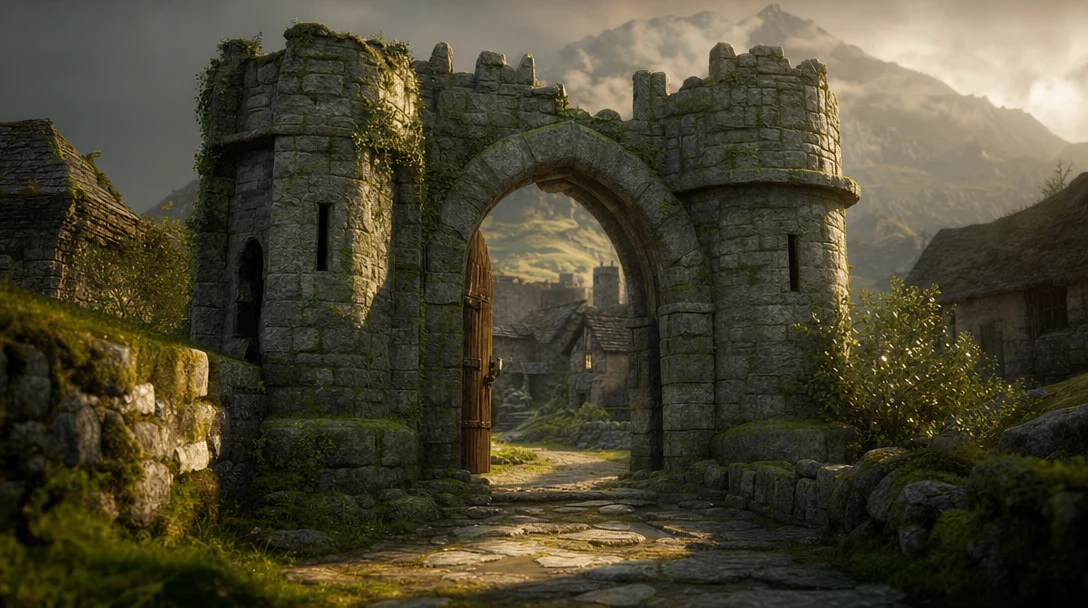
Consider a concrete case. A world model produces a medieval courtyard: cobblestones, a well, a market stall, torches on the walls. As a render, it is excellent. Now a game team wants to ship it. Suddenly the questions are practical:
Can I select just the market stall and reuse it in three other levels?
Are the cobblestones one welded mesh or separable instances?
What is the polygon budget, and does the well have collision geometry?
Are the materials real PBR maps, or baked lighting fused into a diffuse texture?
If the art director says "make the torches warmer," can I change that without regenerating the entire scene and losing everything else?
Can two artists work on it at once, and can the lead approve a version?
Does it export as FBX or GLB with intact material slots and a sane object hierarchy?
A pure generative output usually answers "no" to most of these. That is not a flaw in the model. It is a category difference. The model produced *spatial possibility*. The team needs *spatial work* — and work has structure, history, ownership, and a destination.
What A World-Model Output Is Missing
A world model is trained to predict a coherent spatial environment: it outputs geometry, surfaces, and layout that look internally consistent. That is a genuinely hard problem, and it is exactly the wrong thing to confuse with a finished asset. The output is a snapshot of a possibility, not a set of parts a person can pick up and direct.
The same shape played out one dimension down. Image generators became useful at scale only once editing, layers, masks, versioning, and export sat around them — the model produced the picture, but the tooling made it work. Spatial generation now sits where image generation sat a few years ago: impressive at the output, undirectable underneath.
A world-model output that a team can actually use needs layers the raw generation does not include:
Assets they can isolate, name, and reuse across projects.
A scene graph with objects, scale, position, hierarchy, and parenting.
Cameras and lighting they can direct, not just inherit.
Materials they can inspect and reassign — albedo, normal, roughness, metallic, ORM — rather than baked-in pixels.
State so a decision made on Tuesday survives the regeneration on Wednesday.
Versions they can branch and compare side by side.
Constraints — costume, geography, continuity, brand rules — that persist across outputs.
Collaboration so review and approval are part of the process, not an email afterward.
Export into engines, DCC tools, and production systems with intact topology and materials.
Strip those away and the generated world is a demo. Add them and it becomes a pipeline. Notice that none of these layers are properties of the model — they are properties of the workspace the model feeds. A larger model produces a denser, more detailed snapshot; it does not produce the snapshot's edit history, its material slots, or its review state.
Before And After: The Same Output, Two Outcomes
The clearest way to see the gap is to put a raw generation next to the same asset inside a 3D workflow. The model output is identical. What changes is everything around it.
Production need | Raw world-model output | Inside a 3D workflow |
|---|---|---|
Reuse a single object | Manual cut-out, often a fused mesh | Selectable, named asset reusable across scenes |
Change one material | Regenerate and lose other edits | Reassign one PBR slot, keep the rest |
Adjust a camera | Re-prompt and hope | Direct camera, lens, and framing as data |
Keep a decision across iterations | No memory; drift between runs | Persistent state and constraints |
Compare two directions | Two separate renders to eyeball | Branched versions, side-by-side |
Team review | Screenshots in chat | Shared canvas with review states |
Hand off to an engine | Uncertain topology and materials | Clean FBX/GLB/USD with material slots intact |
The right-hand column is not a better model. It is a workspace. The output started in the same place; the workflow is what made it shippable.
Why 3D Specifically — Not Just Any Workflow
3D creation is inherently structured, and that structure is exactly what a workflow has to represent. A scene is not pixels. It is objects with scale and position, a hierarchy that says the wheel belongs to the car, lighting that should not be melted into the texture, cameras that move on paths, materials that have to behave consistently under different lights, and often rigging, animation, or interaction on top.
Those relationships have to live *somewhere*. If a model generates an environment but the creator cannot reliably grab the parts, reassign a surface, or reposition a light, the output is impressive and undirectable at the same time. A 3D workflow gives the generated world a practical shape: object organization, scene-graph structure, material assignments, camera control, export rules, review states, editable versions, and reusable node graphs that capture *how* the result was made so it can be remade or varied later.
This is why node-based workflows matter so much for spatial AI. A node-based 3D workflow makes the steps visible: a concept node feeds a base mesh, which branches into variations, which run through a retexture step, with side-by-side outputs and a final export. When the world model is one node in that graph instead of the whole product, its output becomes editable, comparable, and repeatable — which is the difference between a one-off and a repeatable production process.
The Gap Between Research And Production
Frontier demos answer "what is becoming possible?" Production tools answer a colder question: "what can a team reliably ship tomorrow?" That gap is where workflow products earn their value.
A creative team does not only need a model to imagine a space. It needs to choose the useful parts, preserve decisions, attach meaning to objects, pass work between people, and move the output into the next system in the chain. None of that is a generation problem; it is a tooling problem. And the direction matters: as world-model research improves, the demand for tools that make spatial output usable *increases* rather than shrinks. A denser output is more material flowing into a pipeline that still has to organize, review, and export it — more objects to name, more surfaces to reassign, more relationships to keep from drifting between runs.
This is the single most counterintuitive point in the whole debate, so it is worth stating once and clearly: progress on the model side does not reduce the workflow problem, it enlarges it. People expecting better models to make 3D tooling obsolete have the dependency backwards.
Where Generated Worlds Break In Practice
The abstract gap becomes concrete the moment a specific team tries to ship a specific deliverable. The failure is rarely "the world looked bad." It is "the world could not be turned into the thing we needed." Three recurring break points:
The first is part reuse under a budget. A game team can prompt a market courtyard in seconds, but a level needs the same stall in four locations at a fixed triangle count, with collision on the well and a separable torch it can swap for an unlit prop. A fused, single-mesh world cannot answer that. The work that closes the gap is not more generation — it is the game-asset pipeline that takes a generated start through retopology, LODs, and engine-ready export.
The second is continuity across many outputs. A cinematic team does not render one world; it renders the same world from forty angles across a sequence, and the audience notices the instant a wall, a costume, or the light direction shifts between shots. A world model regenerated per shot drifts. The fix is to treat one persistent 3D scene as the source of truth and the model as a render layer on top of it — the reason VFX scenes stay consistent instead of flickering frame to frame.
The third is a locked subject in a changing context. A product team needs the *product* to stay identical — exact proportions, exact materials — while the environment around it changes for each campaign image. A generated world treats the product as just more geometry to reinvent on every run, so it warps. Locking the asset and varying only the scene is a workflow operation, not a generation one.
None of these three are solved by a smarter model. They are solved by selection, persistent state, and controlled variation. The decision criteria below summarize what separates a usable world-model workflow from a flashy generator.
Capability | Why it decides usability | Generation alone | Workflow platform |
|---|---|---|---|
Asset extraction | Reuse drives ROI on every generation | Limited | Strong |
Scene editing | Layout, camera, lighting must be directable | Weak | Strong |
Material control | Surfaces must behave consistently in production | Often baked | Editable PBR |
Persistent state | Decisions must survive iteration | None | Built in |
Collaboration | Production is a team sport | Single-player | Multiplayer + review |
Export integrity | Work has to move downstream cleanly | Inconsistent | Standardized FBX/GLB/USD |
Repeatability | Pipelines need to rerun and vary steps | One-shot | Node graphs |
When you are choosing tools for spatial AI, score them on this list, not on the demo reel. The most impressive single output rarely wins; the asset you can edit, approve, and export ten times wins.
Saying It Without Overclaiming
A point worth making plainly, because the temptation to overclaim around world models is strong: a creation platform like Customuse is not a foundational world-model lab, a robotics company, or a physical-AI simulation provider, and pretending otherwise would be both false and beside the point. Customuse does not train world models. It builds the workspace that sits *after* the model — where assets, scenes, materials, cameras, and exports become directable work.
Practically, that means the generator is a component, not the product. Tools like Meshy, Tripo, and Hunyuan are strong at raw generation and plug in as model nodes; Customuse's job is the layer around them — a scene graph, persistent state, real-time multiplayer, and engine-ready export. Whichever lab wins the world-model frontier, the people doing daily creative work still need somewhere to build a game level, a cinematic shot, a product scene, or a reusable asset library — and then ship it. That somewhere is the workspace, not the model.
Bottom Line
Treat a generated world as a starting frame, not a finished asset, and the rest of the decision gets clear. Whoever ships the most spatial work will not be whoever has the best raw generation; it will be whoever can reliably pull parts out of an output, keep them consistent across iterations, review them as a team, and export them clean into the next system. The model hands you a world. Everything you actually do with it happens in the workflow.
FAQ
What is a world model in AI?
A world model is an AI system that can represent, generate, or reason about spatial environments and how they change over time. In creative contexts it means a model that can produce a coherent 3D scene or environment from a prompt or reference, rather than a single flat image. The key limitation for production is that a generated world is an output, not an editable, structured, shareable workspace.
Why do world models need 3D workflows?
Because a generated world is not yet work. Production teams need to select and reuse objects, inspect and reassign materials, direct cameras and lighting, preserve decisions across iterations, review changes as a team, and export clean files into engines or DCC tools. Those layers are not part of the raw generation — they are what a 3D workflow adds, and they are what turn a demo into a shippable asset.
Is a better world model enough to replace a 3D workflow?
No. A better model produces a better starting point, but it cannot give you asset reuse, persistent state, version branching, collaboration, or export integrity — those live in the workspace, not the weights. If anything the dependency runs the other way: a richer output is more material to organize, control, review, and hand off, so generation gains add to the workflow load rather than removing it.
Where does a generated world actually break for a real team?
At the point of a specific deliverable. A game team hits a wall when a fused, single-mesh world can't yield a reusable prop at a fixed triangle budget with collision. A cinematic team hits it when a per-shot regeneration drifts and a wall or costume changes between angles. A product team hits it when the subject that must stay identical warps because the model treats it as fresh geometry every run. Each is a structure-and-state failure, not a fidelity failure — which is why a sharper model doesn't fix it.
What should I look for in a tool for spatial AI work?
Look past the demo reel and score tools on production capabilities: can you extract and reuse individual assets, edit materials as real PBR maps, direct cameras and lighting, keep state across iterations, branch and compare versions, collaborate with a team, and export clean FBX/GLB/USD with intact hierarchies and material slots? The tool that lets you edit, approve, and export an output ten times will beat the one with the single most impressive generation.