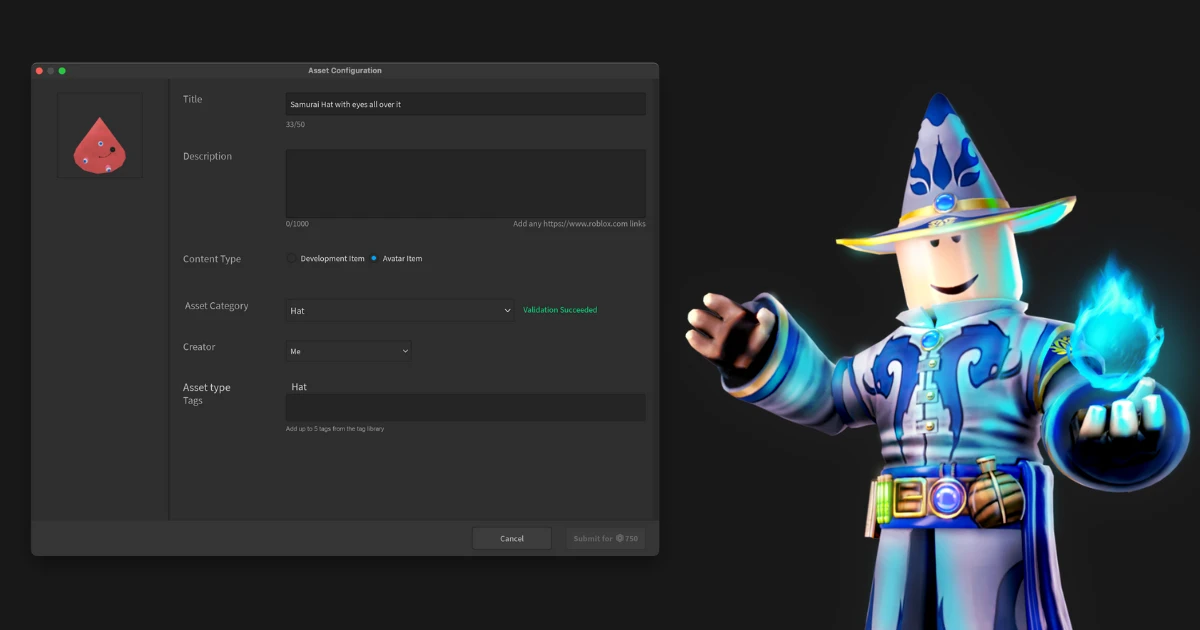
Discover how to create Hats and Masks in Customuse for Roblox ("Rigid Accessories" in Roblox lingvo) and how to upload and use them for your Roblox avatar. In this guide you will go through the whole process from creating a Hat to wearing it on your Roblox Avatar.

Please note that Roblox divides 3D clothing into Layered Clothing and Rigid Accessories. Layered Clothing changes shape with the shape of your avatar – these are shirts and pants. Rigid Accessories (masks, hats) never change shape. This guide is for Rigid Accessories. If you are looking to create a 3D shirt, please follow this guide.

You will need:

  1. A desktop device with Roblox Studio installed

  2. A Roblox account with age verified and at least 1 750 Robux. If you need Robux to get started, join our Discord server. You can participate in challenges there and if you win, we give away Robux as a prize!

Step 1: Saving your hat in Customuse

Once you're satisfied with your hat or mask in Customuse, the first step is to save it.

After clicking 'Save', give your design a unique name and description. Description is optional but it's better to add it as it makes your design more discoverable on Customuse and on Google search. Click 'Publish' to proceed. After publishing you will see the Download button.

Pro users don't have to publish their designs to download them. Free users can only download published designs. You can find your private designs in the "Private" tab of your profile. The published designs are placed in the "Published" tab.

Step 2: Importing into Roblox Studio

When you download your design from Customuse, you receive a .FBX 3D model file. To import your asset into Roblox Studio please do the following:

  1. Open Roblox Studio (download it) and sign in with your Roblox account.

  2. Navigate to the Avatar tab and select Import 3D.

  3. In the file browser, select the .FBX file from the folder downloaded from Customuse. The 3D Importer loads a preview of the object.

Add a new Mesh to Roblox Studio to import it as a Roblox Accessory

See Roblox Studio tutorial for more details.

Step 3: Converting into Accessory and Positioning it on the Avatar

We are almost done! The last step in the process of clothing creation requires you to use the Accessory Fitting Tool to convert this object to a standard Accessory that avatar characters can equip. Unlike the Layered Clothing (e.g. Shirts and Pants), Accessory must be also correctly positioned relative to the avatar!

If you don't like text tutorials, follow this video!

To generate the accessory object:

  1. In the Avatar tab, select the Accessory Fitting Tool. The Accessory Fitting Tool panel displays on the left side of the workspace.

  2. Select the Model of the clothing item in the viewport. The tool's text field populates with the name of the object selected. Alternatively, you can select the object within the Explorer window.

  3. On the Asset Type page, select the type of asset and the expected body type.

    1. Select Accessories, then select the applicable category such as Hat, Eyewear, etc.

    2. Body type is very important for Accessories and affects how accessories are applied. At the time of writing, Customuse-made Accessories are prepared for Classic Blocky body type. Learn more in the Roblox article.

  4. Test out various sample characters, clothing, and animations. See Testing Accessories for additional information.

    1. If the design does not behave as you expect, reach out to our team! We will help you.

  5. Move the accessory within the cage either by dragging on the handles (remember to hold SHIFT to make it smooth!) or by changing the Position value in the bottom right corner of the window. See this video on how to do it

  6. When ready to generate your accessory, click Generate Legacy (!) MeshPart Accessory. This generates a copy of your Accessory which can be published to Roblox.

Step 4: Previewing on your Roblox avatar

In the previous step we tested the hat on the default Roblox avatars. However, it is important to test that it sits well on your Roblox avatar before you pay Robux to upload it! Luckily, this is really easy to do. Watch this video or follow the text steps below:

  1. Go back to the Avatar tab in Roblox Studio and select Rig Builder.(it's next to Import 3D button you pressed earlier)

  2. In the opened window select "My avatar".

  3. You will see your avatar imported in Roblox. If you have weak connection, this may take a short while

  4. In the Explorer menu on the right find your newly-created Accessory and drag into the "Rig". You can locate both of them by clicking on your Avatar and your Accessory respectively

Step 5: Publishing to Roblox

Finally, your item is ready. Find it in the Explorer, right-click on it and select "Save to Roblox"

A GIF tutorial describing how to save your Roblox Accessory to Roblox

You will need to verify your age on Roblox

Then enter the details and press Upload! You will have to pay 750 Robux per each Accessory uploaded

Wait for your item to pass Roblox moderation and then you can put it on sale on the Roblox website. Note that you will have to pay a Publishing Advance to publish!

More resources

Account, Billing & Subscriptions Help

Account, Billing & Subscriptions Help

Manage your Customuse account, plan, and payments — and find the steps for cancelling, refunds, and account deletion.

Troubleshooting Common Issues in Customuse

Troubleshooting Common Issues in Customuse

Quick fixes for the most common Customuse issues — stuck generations, export problems, sign-in trouble, and credits.

How to Request a Feature in Customuse

How to Request a Feature in Customuse

How to suggest a new feature or improvement to Customuse, and what makes a request easy to act on.

How to Report a Bug in Customuse

How to Report a Bug in Customuse

What to include in a bug report and where to send it so the Customuse team can reproduce and fix it quickly.

Contact Customuse: How to Reach the Team

Contact Customuse: How to Reach the Team

The fastest ways to get in touch with Customuse — Discord, email, and our social channels — and which one to use.

Customuse vs Tripo: Image-to-3D or Full AI 3D Workflow?

Customuse vs Tripo: Image-to-3D or Full AI 3D Workflow?

Compare Customuse and Tripo across image-to-3D, text-to-3D, game assets, workflow control, collaboration, agents, and production handoff.

AI 3D Asset Pipeline: From Prompt to Production-Ready Files

AI 3D Asset Pipeline: From Prompt to Production-Ready Files

An AI 3D asset pipeline turns generation into usable production work. Learn the steps from prompt and reference to cleanup, materials, export, and review.

Production-Ready AI 3D Asset Checklist

Production-Ready AI 3D Asset Checklist

A practical checklist for deciding whether an AI-generated 3D asset is ready for games, VFX, product visualization, ecommerce, or studio production.

AI 3D Tools for Game Assets: Concept to Engine-Ready

AI 3D Tools for Game Assets: Concept to Engine-Ready

A production-focused guide to choosing AI 3D tools for game assets, covering concepts, meshes, retopology, PBR textures, rigging, and engine exports.

Best AI 3D Tools for VFX Artists, Ranked and Scored

Best AI 3D Tools for VFX Artists, Ranked and Scored

VFX artists should compare AI 3D tools by shot control, scene context, asset reuse, camera direction, material quality, and handoff.

AI 3D Asset Generator: From Concept to Production-Ready

AI 3D Asset Generator: From Concept to Production-Ready

A production-focused guide to AI 3D asset generators, from concept speed to topology, texturing, rigging, export, and team workflow.

AI 3D Node Editor: The Workflow Layer for Modern 3D Creation

AI 3D Node Editor: The Workflow Layer for Modern 3D Creation

How AI 3D node editors turn generation, references, models, textures, agents, and exports into visible workflows teams can control.

Image to 3D Model: From Reference to Usable Asset

Image to 3D Model: From Reference to Usable Asset

Learn how image-to-3D tools work, where they fail, and how to turn a reference image into an asset that can move into a real 3D workflow.

AI to 3D Game Character With Skins

AI to 3D Game Character With Skins

A full AI character workflow for games, based on a Customuse tutorial covering part extraction, low-poly generation, UV cleanup, texture variants, Blender assembly, rigging, and Unreal Engine handoff.

AI Agents for 3D Game Art

AI Agents for 3D Game Art

A practical explanation of AI agents for 3D game art, based on Customuse Shorts showing node-based workflows for concept, high-poly generation, retopology, baked normals, and engine handoff.

Best AI 3D Tools in 2026: Generators to Production

Best AI 3D Tools in 2026: Generators to Production

A practical guide to the best AI 3D tools by use case, including model generators, image-to-3D tools, workflow platforms, VFX tools, and game asset pipelines.

Making Game-Ready 3D Models With AI

Making Game-Ready 3D Models With AI

A practical AI game-asset workflow based on a Mars rover and alien enemy case study, covering concept generation, multi-view 3D, retopology, texturing, Unity handoff, and final inspection.

Text to 3D Model: From Prompt to Production Workflow

Text to 3D Model: From Prompt to Production Workflow

A guide to text-to-3D model generation, where prompts work well, where they break, and how to turn prompt outputs into usable 3D assets.

Customuse vs Meshy: AI 3D Generator vs Workflow Platform

Customuse vs Meshy: AI 3D Generator vs Workflow Platform

A practical comparison of Customuse and Meshy for AI 3D generation, game assets, workflow control, team production, and exports.

AI 3D Workflow Tool: Production Beyond a Generator

AI 3D Workflow Tool: Production Beyond a Generator

A category-defining guide to AI 3D workflow tools and why nodes, agents, collaboration, memory, and exports matter after the first model.

AI 3D Model Generator: How to Choose One for Real Production

AI 3D Model Generator: How to Choose One for Real Production

A practical guide to AI 3D model generators, what they can do today, and why the best workflow is more than a prompt-to-mesh tool.

AI 3D Tools for VFX: Scene Control Beats Prompt Rerolls

AI 3D Tools for VFX: Scene Control Beats Prompt Rerolls

A guide to AI 3D tools for VFX, cinematic workflows, scene control, camera blocking, continuity, and directed AI rendering.

AI VFX Tools: Where 3D Fits Into the New Creative Stack

AI VFX Tools: Where 3D Fits Into the New Creative Stack

AI VFX tools are changing how creators think about shots, assets, and production. Learn why 3D scenes and workflows matter as much as generation.

Production-Ready AI 3D Assets: For What, at What Cost

Production-Ready AI 3D Assets: For What, at What Cost

"Production-ready" is not a fixed label — it is ready for a specific destination and stage. How to triage AI 3D assets and decide when readiness pays.

AI 3D Workflow: How Teams Move From Prompt to Production

AI 3D Workflow: How Teams Move From Prompt to Production

AI 3D workflows help creators move from prompts and references into usable assets, scenes, exports, and production handoff.

AI 3D Model Generator: What Matters After the First Mesh

AI 3D Model Generator: What Matters After the First Mesh

AI 3D generation is useful, but the first mesh is only the beginning. Learn what makes an AI-generated model usable in real creative workflows.

AI 3D for VFX Artists: Scenes, Assets, and Shot Control

AI 3D for VFX Artists: Scenes, Assets, and Shot Control

AI 3D can help VFX artists with assets, scene setup, shot planning, references, and spatial control, but prompts alone are not enough.

Meshy vs Tripo vs Customuse: Which AI 3D Tool Wins?

Meshy vs Tripo vs Customuse: Which AI 3D Tool Wins?

Compare Meshy, Tripo, and Customuse by generation quality, image-to-3D, text-to-3D, workflow control, game assets, VFX use cases, and production handoff.

Meshy Alternatives: AI 3D Tools for Workflows & VFX

Meshy Alternatives: AI 3D Tools for Workflows & VFX

Looking for Meshy alternatives? Compare AI 3D tools by workflow fit, image-to-3D, text-to-3D, game asset creation, VFX use cases, and production readiness.

Image to 3D Model: Turn a Reference Into a Usable Asset

Image to 3D Model: Turn a Reference Into a Usable Asset

Turning an image into a 3D model is powerful, but production workflows need more than a good preview. Here is what to check before using the asset.

Best Text to 3D Tools in 2026: What to Compare

Best Text to 3D Tools in 2026: What to Compare

A practical guide to text-to-3D tools, prompt quality, model inspection, workflow fit, export formats, and production-readiness.

Text to 3D Model: How to Turn a Prompt Into a Usable Asset

Text to 3D Model: How to Turn a Prompt Into a Usable Asset

Text-to-3D tools can move fast, but prompts need inspection, refinement, scene context, and export checks before the model is useful.

AI Scene Generation: From Single Assets to Worlds

AI Scene Generation: From Single Assets to Worlds

AI scene generation is about more than producing one object. Learn how assets, layout, camera, materials, and workflow create useful 3D scenes.

Best AI 3D Tools for Game Developers in 2026

Best AI 3D Tools for Game Developers in 2026

Game developers should compare AI 3D tools by asset quality, engine readiness, optimization, material control, scene context, and export workflow.

Export AI 3D Assets for Unity: A Handoff Checklist

Export AI 3D Assets for Unity: A Handoff Checklist

Exporting AI 3D assets for Unity requires checks for format, scale, pivot, materials, textures, optimization, cleanup, and scene context.

AI 3D Workspace: Why You Need More Than a Prompt

AI 3D Workspace: Why You Need More Than a Prompt

An AI 3D workspace gives creators control over assets, scenes, references, materials, cameras, versions, collaboration, and exports.

AI for VFX: Why Scenes Matter More Than Prompts

AI for VFX: Why Scenes Matter More Than Prompts

Prompts are useful for AI VFX, but scenes give creators more control over camera, scale, materials, composition, and continuity.

Generate Game-Ready Props with AI, No Cleanup Debt

Generate Game-Ready Props with AI, No Cleanup Debt

Learn a practical workflow for generating AI game props, inspecting them, placing them in context, and preparing them for engine handoff.

Best Image to 3D Tools in 2026: How to Choose

Best Image to 3D Tools in 2026: How to Choose

Compare image-to-3D tools by reference quality, mesh usability, material control, scene context, exports, and production workflow.

Best AI 3D Model Generators in 2026: How to Choose

Best AI 3D Model Generators in 2026: How to Choose

A practical guide to choosing an AI 3D model generator for real creative work, from first mesh quality to scene control, exports, and production workflow.

Tripo Alternatives: Best AI 3D Tools for 2026

Tripo Alternatives: Best AI 3D Tools for 2026

Compare Tripo alternatives by image-to-3D quality, text-to-3D, workflow control, game asset fit, VFX use cases, and production handoff.

AI Agents Come to the Nodes Editor

AI Agents Come to the Nodes Editor

You can now collaborate with AI Agents directly inside the Nodes Editor — chat from a workflow, ask for node edits, and hand off larger tasks with budget controls.

More Reliable 3D Exports & Workflow Previews

More Reliable 3D Exports & Workflow Previews

Dedicated GLB/FBX export menus, transparent-background rendering, and smoother artifact reuse make getting assets out of Customuse more reliable.

Smarter Media History: Every Output Is Its Own Asset

Smarter Media History: Every Output Is Its Own Asset

Generated media is now handled as individual assets — with per-item deletion, dedicated video renditions, and faster history browsing.

Real-Time Workflow Collaboration + Auto Rig

Real-Time Workflow Collaboration + Auto Rig

Faster room joining, clearer presence, one-click workflow duplication, and a new Auto Rig node that makes 3D models animation-ready.

A Streamlined 3D Creation Onboarding

A Streamlined 3D Creation Onboarding

A refreshed homepage and onboarding flow guide new creators toward 3D and media workflows faster, with clearer model descriptions.

How to upload Roblox Classic Clothing directly into Roblox from Customuse

How to upload Roblox Classic Clothing directly into Roblox from Customuse

Send Roblox Classic Clothing directly into Roblox without leaving the Customuse Editor. This tutorial will help you navigate it. Let's get started!

How to Upload a Shirt in Roblox: a Step-by-Step Guide

How to Upload a Shirt in Roblox: a Step-by-Step Guide

Bring your Customuse designs to life in Roblox. Our guide explains how to save, publish, and upload your unique outfits to Roblox, making your avatar stand out.

How to upload a 3D Shirt or Accessory to Roblox: a Step-by-Step Guide

How to upload a 3D Shirt or Accessory to Roblox: a Step-by-Step Guide

Discover how to share your Roblox Clothes and Accessories from Customuse and use them for your Roblox Avatar. This guide will walk you through each step from saving your design in Customuse to wearing it on your Roblox Avatar.

How to link your Roblox account to your Customuse account

How to link your Roblox account to your Customuse account

Link your Roblox account to Customuse to upload and preview designs. Must select an account during linking (most common error). Ensure your Roblox account is set to 13+ years and you have proper permissions for group uploads.

How to Create 3D Assets with Customuse

How to Create 3D Assets with Customuse

Create 3D assets in seconds with Customuse AI - no technical skills needed! Transform ideas into game-ready models instantly. Learn the fastest method here.

How to Easily Create and Upload a Roblox Shirt on Your Phone

How to Easily Create and Upload a Roblox Shirt on Your Phone

Easily create and upload a custom Roblox shirt from your phone using the Customuse app! Remix designs, add accessories, and upload directly to Roblox. Follow this quick guide to design and sell your shirt in just minutes!

Cancel your subscription

Cancel your subscription

Looking to leave Customuse? Learn how to cancel your subscription.

Request a refund

Request a refund

How to request a refund if you have purchased Customuse Pro by mistake

Delete your account

Delete your account

Learn how to delete your account from Customuse

This site uses cookies to improve your experience. By continuing, you accept our Privacy Policy.
Manage