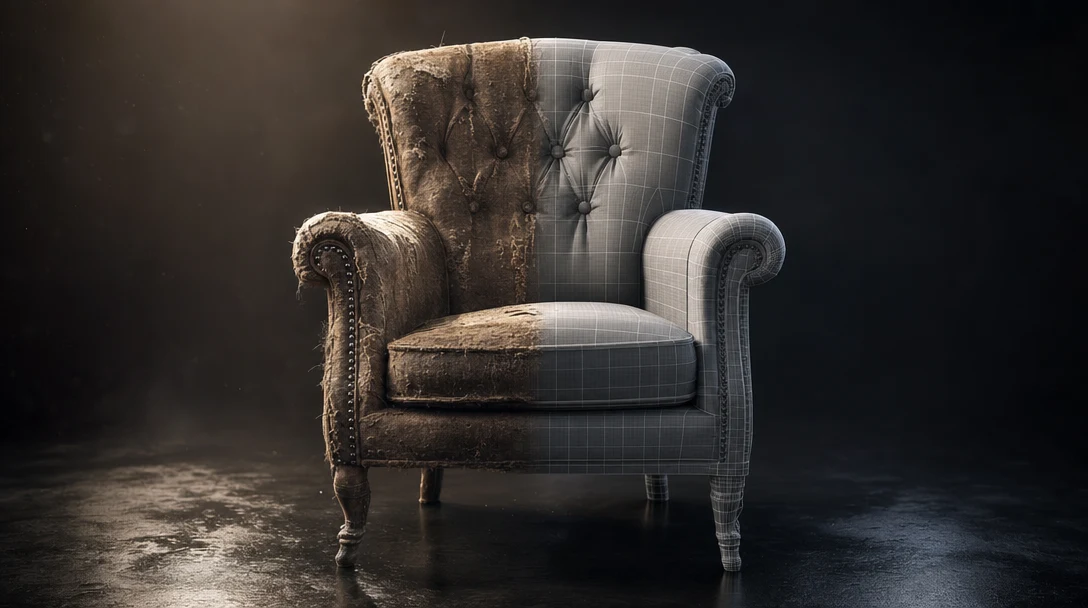
The "vs" in this title is misleading, and it trips up most people who ask the question. Gaussian splats and polygon meshes are not two flavors of the same thing the way GLB and FBX are two file formats for the same mesh. One is a way of *recording* what a camera saw; the other is a way of *building* something a tool can manipulate. Putting them head-to-head is a bit like asking whether a photograph beats a sculpture. The honest answer is that the question only resolves once you say what you intend to do with the result.

So this guide is organized around a single decision: do you need to capture a space, or control an object? Everything else follows from that.

Quick Answer

Use Gaussian splats when the input is the real world and you mostly want to move a camera through it: capturing a room, a set, or a product space with photoreal detail in minutes. Use polygon meshes when the asset has to be edited, rigged, optimized, collided with, animated, or exported into a game engine or DCC tool. Splats win on captured realism and speed; meshes win on control and handoff. They are not competing for the same job, and most real pipelines run both at once.

Why a Splat Cannot Do What a Mesh Does

A 3D model is an explicit surface: vertices, edges, faces, UVs, materials, textures. Every face is something you can select, move, retopologize, weight, or paint. That explicit structure is precisely what game engines, riggers, physics solvers, and animation tools are built to expect. The mesh is editable because the surface is *there*.

A Gaussian splat has no surface at all. It stores millions of small, soft, colored 3D points, each carrying a position, scale, orientation, color, and view-dependent opacity. Rendered together, those points reconstruct what a camera saw from many angles, soft reflections and fuzzy foliage and baked lighting included. There is nothing to grab. You cannot select a face on a splat because there are no faces. That absence is the whole story: it is why a splat captures a forest canopy in a way no one would model by hand, and also why you cannot rig it, give it collision, or relight it cleanly.

Hold that one fact and every trade-off below becomes predictable. If a task involves *changing* the asset, the mesh leads. If a task involves *recording reality fast*, the splat leads. For the underlying mechanics, see What Is a Gaussian Splat?.

The Trade-Off Map

The table below is a map of jobs, not a scoreboard. Notice the pattern: almost every row where splats read "Limited" is a row about modifying the asset, and almost every row where they read "Strong" is about capturing the real world quickly. The two formats are sorted by what they were designed for.

Dimension

Gaussian Splats

3D Models (Meshes)

Capture from photos/video

Strong, fast pipeline

Possible via photogrammetry, slower and noisier

Photoreal look from real input

Strong, baked lighting and view-dependent detail

Depends on modeling, UVs, and material work

Editable topology

None, no surface to edit

Strong, full vertex/face control

UVs, rigging, skinning, deformation

Not supported

Strong, mature tooling

Collision and physics

Not supported

Strong

Game engine optimization

Viewer/runtime dependent

Strong when retopologized and LOD'd

Hard edges and precise shapes

Weak, soft by nature

Strong

Relighting in a new scene

Hard, lighting is baked in

Straightforward with PBR materials

Standard exports (FBX, GLB, USD, OBJ)

Still maturing

Mature and universal

Engine/DCC compatibility

Needs splat-aware viewer or plugin

Native across Blender, Unity, Unreal, Maya

File size for complex scenes

Often large, scales with point count

Controllable via LODs and compression

Best when you want to

Show what a space looked like

Control what an object can do

Where Splats Earn Their Place

Reach for splats when the input is the real world and the output needs to look spatially convincing fast:

  • Capturing a physical set, room, or product space for review the same day it was shot.

  • Moving a virtual camera through a real environment for previs or location scouting.

  • Sharing spatial context with a distributed team without anyone rebuilding the space by hand.

  • Preserving real lighting and surface appearance straight from capture, including the messy detail that materials only approximate.

  • Building immersive web previews and interactive backdrops a viewer can orbit.

The deciding question is whether the goal is to faithfully record *what something looked like*. If so, a splat is usually the most efficient path: a usable, navigable scene from a phone video in minutes, which no manual modeling workflow matches.

Where Meshes Are the Only Real Answer

Reach for meshes when the asset has to be changed, shipped, animated, optimized, or dropped into an established pipeline:

  • Game props, weapons, vehicles, and environment kits.

  • Characters that need rigging and animation.

  • Product visualization where you swap materials, recolor, or relight the hero per shot.

  • Engine-ready assets with predictable performance and collision.

  • Anything that must survive retopology, UV unwrapping, and PBR texturing.

  • Clean handoff to Blender, Unity, or Unreal Engine.

If the goal is to control *what something can do*, a mesh wins almost every time. This is also why AI generators that output meshes, such as Meshy, Tripo, and Hunyuan, remain the backbone of game and product pipelines: their output drops into the same FBX/GLB/USD plumbing artists already use.

The Conversion Trap

A common hope is to skip the choice entirely by converting a splat into a mesh. Splat-to-mesh extraction is real and improving fast, and on the right capture it gives you a usable head start. But extraction reconstructs a surface that was never there, so it tends to produce dense, noisy, irregular geometry: bumpy where the real surface was flat, holes where the capture was thin, no clean topology for animation, and baked lighting fused into the result. You inherit a draft, not a deliverable.

The realistic plan is to budget cleanup. Expect retopology, UV work, and material rebuilding before an extracted mesh is engine-ready, and judge the time you save against the time that cleanup costs. On a simple static prop the math often favors extraction; on a hero asset that must animate, modeling fresh from the splat as visual reference is frequently faster than fixing the extracted geometry.

A One-Hour Bake-Off to Settle It for Your Project

Generic comparisons stall because the right answer is project-specific. Resolve it by running one real deliverable through both formats and timing the whole thing. Pick a concrete object in a concrete space (say, a hero prop sitting in a captured room) and grade against the deliverable, not against the format:

  1. Name the actual output first. An engine-ready prop, a navigable web scene, or a previs camera move are three different tests. Decide which one you are shipping.

  2. Capture once, feed both. Use the same photos or video for the splat and as reference for the mesh, so the comparison is fair.

  3. Push past the first result. A splat will look finished in ten minutes. Then try to do the actual job: relight it, give it collision, animate it, export it to your target engine. This is where the two formats separate hard, and splats often lose the last two hours of the test even though they won the first ten minutes.

  4. Record time-to-final, not time-to-first-look. The number that matters is total hours to a shippable result, including every round of cleanup.

If the deliverable is mesh-side, run the result through the production-ready AI 3D asset checklist before you call it done. That single timed exercise usually ends the format debate faster than any spec sheet, because it surfaces the cleanup cost that comparison tables hide.

Running Both in One Scene

The strongest pipelines stop choosing and combine the two. A mixed workflow typically goes:

  1. Capture the location as a Gaussian splat.

  2. Use the splat as spatial reference and as a backdrop layer.

  3. Generate or import clean meshes for anything that has to be edited or interactive.

  4. Place those meshes inside the scene, against the splat, for scale and lighting context.

  5. Tune camera, scale, lighting, and materials until the meshes sit believably in the capture.

  6. Export the editable meshes into production and keep the splat as context.

A film location capture, a product environment, and a game backdrop all follow the same logic for the same reason: the splat carries the real-world context cheaply, and the mesh carries everything that has to move, deform, or ship. Neither replaces the other, and trying to force one into the other's role is where most splat-vs-mesh frustration actually comes from.

This is the kind of mixed-format scene a 3D workspace should make ordinary rather than heroic. In Customuse, captured spaces, generated assets, editable scenes, materials, cameras, and exports live in one canvas: a splat can sit as reference inside Cinema Studio while mesh assets from provider nodes (Meshy, Tripo, Hunyuan, and others) get retopologized, textured, and exported engine-ready alongside it.

Common Mistakes to Avoid

  • Expecting a splat to behave like a mesh. No rigging, no collision, no clean material edits, no precise hard-surface geometry. Do not promise interactivity from a capture.

  • Expecting a mesh to capture reality instantly. Matching a real space's lighting and texture by hand or by generation takes longer than splatting it.

  • Treating extraction as a finished asset. It is a head start with a cleanup bill attached, not a shipped mesh.

  • Choosing a format before naming the deliverable. The deliverable decides the format, never the reverse.

FAQ

Are Gaussian splats better than 3D models?

No, because they are not solving the same problem. Splats win for fast photoreal capture and camera movement through real spaces; meshes win for editing, rigging, collision, optimization, and clean exports. Ask whether you need to capture a space or control an object, and the choice answers itself. Many projects need both.

Can you convert a Gaussian splat into a mesh?

Yes, and extraction is improving quickly, but it rebuilds a surface that did not exist in the splat, so the result is usually dense, irregular geometry with baked lighting and no clean topology. Plan on retopology, UVs, and material work before it is engine-ready. Treat it as a time-saving draft, not a finished asset.

Should game developers use Gaussian splats?

Mainly for visual environments, backdrops, references, and experiments, and only where the runtime actually renders splats. Interactive game objects still need optimized meshes with clean topology, LODs, PBR materials, and collision, so most shipped game assets are meshes.

Which format is better for VFX?

Both, in different roles. Splats are excellent for set capture, location reference, and camera planning because they preserve real lighting and spatial truth. Meshes carry the controllable elements that must animate, relight, or composite. A typical shot uses a splat for context and meshes for anything that moves or changes.

Why do Gaussian splats look so realistic but render large?

A splat stores view-dependent appearance across millions of points, including soft edges, reflections, and baked lighting that meshes only approximate with materials. That richness is why captures look convincing, and also why file size scales with point count, so a complex splat scene can be far heavier than a well-optimized mesh using LODs and texture compression.



More resources

Troubleshooting Common Issues in Customuse

Troubleshooting Common Issues in Customuse

Quick fixes for the most common Customuse issues — stuck generations, export problems, sign-in trouble, and credits.

Contact Customuse: How to Reach the Team

Contact Customuse: How to Reach the Team

The fastest ways to get in touch with Customuse — Discord, email, and our social channels — and which one to use.

How to Report a Bug in Customuse

How to Report a Bug in Customuse

What to include in a bug report and where to send it so the Customuse team can reproduce and fix it quickly.

How to Request a Feature in Customuse

How to Request a Feature in Customuse

How to suggest a new feature or improvement to Customuse, and what makes a request easy to act on.

Account, Billing & Subscriptions Help

Account, Billing & Subscriptions Help

Manage your Customuse account, plan, and payments — and find the steps for cancelling, refunds, and account deletion.

AI to 3D Game Character With Skins

AI to 3D Game Character With Skins

A full AI character workflow for games, based on a Customuse tutorial covering part extraction, low-poly generation, UV cleanup, texture variants, Blender assembly, rigging, and Unreal Engine handoff.

AI 3D Model Generator: How to Choose One for Real Production

AI 3D Model Generator: How to Choose One for Real Production

A practical guide to AI 3D model generators, what they can do today, and why the best workflow is more than a prompt-to-mesh tool.

AI 3D Node Editor: The Workflow Layer for Modern 3D Creation

AI 3D Node Editor: The Workflow Layer for Modern 3D Creation

How AI 3D node editors turn generation, references, models, textures, agents, and exports into visible workflows teams can control.

AI Agents for 3D Game Art

AI Agents for 3D Game Art

A practical explanation of AI agents for 3D game art, based on Customuse Shorts showing node-based workflows for concept, high-poly generation, retopology, baked normals, and engine handoff.

AI 3D for Cinematic Content: Scenes, Cameras, Shots

AI 3D for Cinematic Content: Scenes, Cameras, Shots

AI 3D can help cinematic creators plan shots, generate assets, build scenes, control cameras, and move from prompts into visual production.

OBJ vs FBX for 3D Workflows: A Guide for AI Assets

OBJ vs FBX for 3D Workflows: A Guide for AI Assets

OBJ and FBX are both common 3D formats, but they solve different workflow problems. Compare them for AI-generated assets, games, VFX, and DCC tools.

AI 3D for Creative Agencies: Concepts to Client Review

AI 3D for Creative Agencies: Concepts to Client Review

AI 3D can help creative agencies create campaign visuals, product scenes, brand worlds, pitch assets, and client-ready prototypes faster.

GLB vs OBJ for Web 3D and AI Assets

GLB vs OBJ for Web 3D and AI Assets

GLB and OBJ are useful for different 3D workflows. Compare them for web 3D, AI-generated assets, review, materials, and production handoff.

Best AI 3D Tools for VFX Artists, Ranked and Scored

Best AI 3D Tools for VFX Artists, Ranked and Scored

VFX artists should compare AI 3D tools by shot control, scene context, asset reuse, camera direction, material quality, and handoff.

What Is a Normal Map? A Practical Guide for AI 3D Assets

What Is a Normal Map? A Practical Guide for AI 3D Assets

Normal maps add surface detail to 3D assets without changing geometry. Learn what they mean for AI-generated models, games, VFX, and materials.

Kaedim Alternatives: AI 3D Production & Pipelines

Kaedim Alternatives: AI 3D Production & Pipelines

Compare Kaedim alternatives by production asset needs, AI generation speed, workflow control, review, exports, and team handoff.

How to Optimize AI 3D Assets for Games

How to Optimize AI 3D Assets for Games

AI 3D assets need optimization before game use. Check polycount, topology, materials, textures, LODs, scale, collision, and engine import.

AI 3D Tools for VFX: Scene Control Beats Prompt Rerolls

AI 3D Tools for VFX: Scene Control Beats Prompt Rerolls

A guide to AI 3D tools for VFX, cinematic workflows, scene control, camera blocking, continuity, and directed AI rendering.

Customuse vs Tripo: Image-to-3D or Full AI 3D Workflow?

Customuse vs Tripo: Image-to-3D or Full AI 3D Workflow?

Compare Customuse and Tripo across image-to-3D, text-to-3D, game assets, workflow control, collaboration, agents, and production handoff.

AI 3D Asset Pipeline: From Prompt to Production-Ready Files

AI 3D Asset Pipeline: From Prompt to Production-Ready Files

An AI 3D asset pipeline turns generation into usable production work. Learn the steps from prompt and reference to cleanup, materials, export, and review.

What Is 3D Model Rigging? A Guide for AI Assets

What Is 3D Model Rigging? A Guide for AI Assets

3D model rigging creates the controls that let a model move. Learn what rigging means for AI-generated assets, games, VFX, and animation.

AI 3D Tools for Game Assets: Concept to Engine-Ready

AI 3D Tools for Game Assets: Concept to Engine-Ready

A production-focused guide to choosing AI 3D tools for game assets, covering concepts, meshes, retopology, PBR textures, rigging, and engine exports.

How to Prepare AI 3D Models for Animation

How to Prepare AI 3D Models for Animation

AI-generated 3D models often need cleanup before animation. Check topology, rigging needs, scale, materials, pivots, and export path.

AI Normal Map Generator for 3D Assets: A Guide

AI Normal Map Generator for 3D Assets: A Guide

AI normal map generators can help create surface detail for 3D assets, but production workflows need lighting tests, material checks, and cleanup.

AI 3D to Blender Workflow: Model to Editable Asset

AI 3D to Blender Workflow: Model to Editable Asset

A practical AI 3D to Blender workflow for inspecting generated models, cleaning geometry, checking materials, and preparing assets for production.

How to Export AI 3D Assets for Blender: A Checklist

How to Export AI 3D Assets for Blender: A Checklist

Exporting AI 3D assets for Blender requires checks for format, geometry, scale, materials, textures, normals, cleanup, and scene context.

Image to 3D Model: From Reference to Usable Asset

Image to 3D Model: From Reference to Usable Asset

Learn how image-to-3D tools work, where they fail, and how to turn a reference image into an asset that can move into a real 3D workflow.

SVG to 3D Model: Turn Vector Art Into Usable 3D

SVG to 3D Model: Turn Vector Art Into Usable 3D

SVG-to-3D workflows can turn logos and vector shapes into 3D assets, but production needs depth, materials, bevels, scene context, and export checks.

What Are LODs in 3D Game Assets? A Practical Guide

What Are LODs in 3D Game Assets? A Practical Guide

LODs help game engines render 3D assets efficiently at different distances. Learn what LODs mean for AI-generated game assets.

Repeatable 3D Workflows With Nodes for AI Creation

Repeatable 3D Workflows With Nodes for AI Creation

Node-based workflows help AI 3D teams move beyond one-off generations into repeatable, editable, and reviewable creative pipelines.

What Is a Scene Graph? Why It Matters for AI 3D Workflows

What Is a Scene Graph? Why It Matters for AI 3D Workflows

A scene graph organizes objects, cameras, lights, materials, and relationships inside a 3D scene. Learn why scene graphs matter for AI 3D creation.

What Is a Gaussian Splat? A Practical Guide for 3D Creators

What Is a Gaussian Splat? A Practical Guide for 3D Creators

Gaussian splats are a fast way to represent real-world scenes in 3D. Learn how they work, where they help, and where meshes still matter.

3D AI Studio Alternatives: Multi-Model AI 3D Tools

3D AI Studio Alternatives: Multi-Model AI 3D Tools

Compare 3D AI Studio alternatives by image-to-3D, text-to-3D, AI texture generation, multi-model testing, scene context, and workflow fit.

Production-Ready AI 3D Asset Checklist

Production-Ready AI 3D Asset Checklist

A practical checklist for deciding whether an AI-generated 3D asset is ready for games, VFX, product visualization, ecommerce, or studio production.

CSM AI Alternatives for 3D Model Generation

CSM AI Alternatives for 3D Model Generation

Compare CSM AI alternatives by image-to-3D, text-to-3D, production readiness, game asset workflow, VFX use cases, and scene control.

What Is Retopology? Cleaner Meshes for AI 3D Models

What Is Retopology? Cleaner Meshes for AI 3D Models

Retopology rebuilds a 3D model with cleaner geometry. Learn why it matters for AI-generated assets, games, VFX, animation, and export.

AI 3D Workflow Tool: Production Beyond a Generator

AI 3D Workflow Tool: Production Beyond a Generator

A category-defining guide to AI 3D workflow tools and why nodes, agents, collaboration, memory, and exports matter after the first model.

World Models Need 3D Workflows

World Models Need 3D Workflows

World models can generate spatial possibility, but creators and teams need workflows for assets, scenes, materials, cameras, review, and export.

UV Unwrapping AI 3D Models: Clean Texture Maps

UV Unwrapping AI 3D Models: Clean Texture Maps

UV unwrapping maps 3D surfaces to 2D texture space. Learn why AI-generated models may need UV cleanup for games, VFX, and product visuals.

Making Game-Ready 3D Models With AI

Making Game-Ready 3D Models With AI

A practical AI game-asset workflow based on a Mars rover and alien enemy case study, covering concept generation, multi-view 3D, retopology, texturing, Unity handoff, and final inspection.

Best AI 3D Tools in 2026: Generators to Production

Best AI 3D Tools in 2026: Generators to Production

A practical guide to the best AI 3D tools by use case, including model generators, image-to-3D tools, workflow platforms, VFX tools, and game asset pipelines.

Text to STL vs Text to 3D Model: Prompts to Print

Text to STL vs Text to 3D Model: Prompts to Print

Text-to-STL and text-to-3D model workflows are not the same. Learn when to target 3D printing versus game, VFX, and scene workflows.

Text to 3D Model: From Prompt to Production Workflow

Text to 3D Model: From Prompt to Production Workflow

A guide to text-to-3D model generation, where prompts work well, where they break, and how to turn prompt outputs into usable 3D assets.

AI 3D for Indie Game Developers: Fewer Cleanup Surprises

AI 3D for Indie Game Developers: Fewer Cleanup Surprises

Indie game developers can use AI 3D for props, placeholders, style exploration, scene dressing, and workflow acceleration if they control cleanup.

Image to STL vs Image to 3D Model: Which to Use?

Image to STL vs Image to 3D Model: Which to Use?

Image-to-STL and image-to-3D model workflows serve different goals. Learn which one fits 3D printing, games, VFX, product visuals, and creative work.

AI 3D for Studios: From Generation to Production

AI 3D for Studios: From Generation to Production

AI 3D can help studios move faster when it supports assets, scenes, review, repeatable workflows, exports, and collaboration rather than one-off outputs.

Sloyd Alternatives: AI 3D Tools for Game Assets

Sloyd Alternatives: AI 3D Tools for Game Assets

Compare Sloyd alternatives by procedural control, image-to-3D quality, game asset fit, workflow support, exports, and production handoff.

What Are PBR Materials? A Practical Guide for AI 3D Assets

What Are PBR Materials? A Practical Guide for AI 3D Assets

PBR materials help 3D assets respond consistently to light. Learn what PBR means for AI-generated models, games, VFX, and product visuals.

Customuse vs Meshy: AI 3D Generator vs Workflow Platform

Customuse vs Meshy: AI 3D Generator vs Workflow Platform

A practical comparison of Customuse and Meshy for AI 3D generation, game assets, workflow control, team production, and exports.

AI 3D for Product Visualization: Model to Visual System

AI 3D for Product Visualization: Model to Visual System

AI 3D can help product teams create scenes, materials, environments, variations, and campaign-ready visuals faster when the workflow stays controllable.

AI Texture Generator for 3D Assets: Production Checks

AI Texture Generator for 3D Assets: Production Checks

AI texture generators can speed up 3D asset creation, but production workflows need material control, consistency, UV quality, and lighting tests.

GLB vs FBX for AI 3D Assets: Which Format Should You Export?

GLB vs FBX for AI 3D Assets: Which Format Should You Export?

GLB and FBX serve different 3D workflows. Learn how to choose the right export format for AI-generated assets, games, web 3D, VFX, and review.

AI 3D Asset Generator: From Concept to Production-Ready

AI 3D Asset Generator: From Concept to Production-Ready

A production-focused guide to AI 3D asset generators, from concept speed to topology, texturing, rigging, export, and team workflow.

Sloyd vs Meshy vs Customuse: Assets, AI, or Workflow?

Sloyd vs Meshy vs Customuse: Assets, AI, or Workflow?

Compare Sloyd, Meshy, and Customuse by structured asset control, AI 3D generation, game asset workflow, scene context, and production handoff.

Generate Game-Ready Props with AI, No Cleanup Debt

Generate Game-Ready Props with AI, No Cleanup Debt

Learn a practical workflow for generating AI game props, inspecting them, placing them in context, and preparing them for engine handoff.

Best AI 3D Model Generators in 2026: How to Choose

Best AI 3D Model Generators in 2026: How to Choose

A practical guide to choosing an AI 3D model generator for real creative work, from first mesh quality to scene control, exports, and production workflow.

Export AI 3D Assets for Unreal: Generation to Import

Export AI 3D Assets for Unreal: Generation to Import

Prepare AI 3D assets for Unreal Engine with checks for mesh quality, scale, materials, texture maps, import behavior, scene context, and cleanup.

AI 3D for VFX Artists: Scenes, Assets, and Shot Control

AI 3D for VFX Artists: Scenes, Assets, and Shot Control

AI 3D can help VFX artists with assets, scene setup, shot planning, references, and spatial control, but prompts alone are not enough.

Best AI 3D Tools for Game Developers in 2026

Best AI 3D Tools for Game Developers in 2026

Game developers should compare AI 3D tools by asset quality, engine readiness, optimization, material control, scene context, and export workflow.

Text to 3D Model: How to Turn a Prompt Into a Usable Asset

Text to 3D Model: How to Turn a Prompt Into a Usable Asset

Text-to-3D tools can move fast, but prompts need inspection, refinement, scene context, and export checks before the model is useful.

AI VFX Tools: Where 3D Fits Into the New Creative Stack

AI VFX Tools: Where 3D Fits Into the New Creative Stack

AI VFX tools are changing how creators think about shots, assets, and production. Learn why 3D scenes and workflows matter as much as generation.

AI 3D Workflow: How Teams Move From Prompt to Production

AI 3D Workflow: How Teams Move From Prompt to Production

AI 3D workflows help creators move from prompts and references into usable assets, scenes, exports, and production handoff.

Export AI 3D Assets for Unity: A Handoff Checklist

Export AI 3D Assets for Unity: A Handoff Checklist

Exporting AI 3D assets for Unity requires checks for format, scale, pivot, materials, textures, optimization, cleanup, and scene context.

Meshy vs Tripo vs Customuse: Which AI 3D Tool Wins?

Meshy vs Tripo vs Customuse: Which AI 3D Tool Wins?

Compare Meshy, Tripo, and Customuse by generation quality, image-to-3D, text-to-3D, workflow control, game assets, VFX use cases, and production handoff.

Tripo Alternatives: Best AI 3D Tools for 2026

Tripo Alternatives: Best AI 3D Tools for 2026

Compare Tripo alternatives by image-to-3D quality, text-to-3D, workflow control, game asset fit, VFX use cases, and production handoff.

AI 3D Workspace: Why You Need More Than a Prompt

AI 3D Workspace: Why You Need More Than a Prompt

An AI 3D workspace gives creators control over assets, scenes, references, materials, cameras, versions, collaboration, and exports.

Production-Ready AI 3D Assets: For What, at What Cost

Production-Ready AI 3D Assets: For What, at What Cost

"Production-ready" is not a fixed label — it is ready for a specific destination and stage. How to triage AI 3D assets and decide when readiness pays.

AI for VFX: Why Scenes Matter More Than Prompts

AI for VFX: Why Scenes Matter More Than Prompts

Prompts are useful for AI VFX, but scenes give creators more control over camera, scale, materials, composition, and continuity.

Meshy Alternatives: AI 3D Tools for Workflows & VFX

Meshy Alternatives: AI 3D Tools for Workflows & VFX

Looking for Meshy alternatives? Compare AI 3D tools by workflow fit, image-to-3D, text-to-3D, game asset creation, VFX use cases, and production readiness.

Image to 3D Model: Turn a Reference Into a Usable Asset

Image to 3D Model: Turn a Reference Into a Usable Asset

Turning an image into a 3D model is powerful, but production workflows need more than a good preview. Here is what to check before using the asset.

AI Scene Generation: From Single Assets to Worlds

AI Scene Generation: From Single Assets to Worlds

AI scene generation is about more than producing one object. Learn how assets, layout, camera, materials, and workflow create useful 3D scenes.

Best Text to 3D Tools in 2026: What to Compare

Best Text to 3D Tools in 2026: What to Compare

A practical guide to text-to-3D tools, prompt quality, model inspection, workflow fit, export formats, and production-readiness.

AI 3D Model Generator: What Matters After the First Mesh

AI 3D Model Generator: What Matters After the First Mesh

AI 3D generation is useful, but the first mesh is only the beginning. Learn what makes an AI-generated model usable in real creative workflows.

Best Image to 3D Tools in 2026: How to Choose

Best Image to 3D Tools in 2026: How to Choose

Compare image-to-3D tools by reference quality, mesh usability, material control, scene context, exports, and production workflow.

AI Agents Come to the Nodes Editor

AI Agents Come to the Nodes Editor

You can now collaborate with AI Agents directly inside the Nodes Editor — chat from a workflow, ask for node edits, and hand off larger tasks with budget controls.

More Reliable 3D Exports & Workflow Previews

More Reliable 3D Exports & Workflow Previews

Dedicated GLB/FBX export menus, transparent-background rendering, and smoother artifact reuse make getting assets out of Customuse more reliable.

Smarter Media History: Every Output Is Its Own Asset

Smarter Media History: Every Output Is Its Own Asset

Generated media is now handled as individual assets — with per-item deletion, dedicated video renditions, and faster history browsing.

Real-Time Workflow Collaboration + Auto Rig

Real-Time Workflow Collaboration + Auto Rig

Faster room joining, clearer presence, one-click workflow duplication, and a new Auto Rig node that makes 3D models animation-ready.

A Streamlined 3D Creation Onboarding

A Streamlined 3D Creation Onboarding

A refreshed homepage and onboarding flow guide new creators toward 3D and media workflows faster, with clearer model descriptions.

How to upload Roblox Classic Clothing directly into Roblox from Customuse

How to upload Roblox Classic Clothing directly into Roblox from Customuse

Send Roblox Classic Clothing directly into Roblox without leaving the Customuse Editor. This tutorial will help you navigate it. Let's get started!

How to Upload a Shirt in Roblox: a Step-by-Step Guide

How to Upload a Shirt in Roblox: a Step-by-Step Guide

Bring your Customuse designs to life in Roblox. Our guide explains how to save, publish, and upload your unique outfits to Roblox, making your avatar stand out.

How to upload a 3D Shirt or Accessory to Roblox: a Step-by-Step Guide

How to upload a 3D Shirt or Accessory to Roblox: a Step-by-Step Guide

Discover how to share your Roblox Clothes and Accessories from Customuse and use them for your Roblox Avatar. This guide will walk you through each step from saving your design in Customuse to wearing it on your Roblox Avatar.

How to upload a Hat or Mask to Roblox: a Step-by-Step Guide

How to upload a Hat or Mask to Roblox: a Step-by-Step Guide

Discover how to create Hats and Masks in Customuse for Roblox (Rigid Accessories in Roblox lingvo) and how to upload and use them on your Roblox avatar. In this guide you will go through the process from creating a Hat to wearing it on your Roblox Avatar.

How to link your Roblox account to your Customuse account

How to link your Roblox account to your Customuse account

Link your Roblox account to Customuse to upload and preview designs. Must select an account during linking (most common error). Ensure your Roblox account is set to 13+ years and you have proper permissions for group uploads.

How to Create 3D Assets with Customuse

How to Create 3D Assets with Customuse

Create 3D assets in seconds with Customuse AI - no technical skills needed! Transform ideas into game-ready models instantly. Learn the fastest method here.

How to Easily Create and Upload a Roblox Shirt on Your Phone

How to Easily Create and Upload a Roblox Shirt on Your Phone

Easily create and upload a custom Roblox shirt from your phone using the Customuse app! Remix designs, add accessories, and upload directly to Roblox. Follow this quick guide to design and sell your shirt in just minutes!

Cancel your subscription

Cancel your subscription

Looking to leave Customuse? Learn how to cancel your subscription.

Request a refund

Request a refund

How to request a refund if you have purchased Customuse Pro by mistake

Delete your account

Delete your account

Learn how to delete your account from Customuse

This site uses cookies to improve your experience. By continuing, you accept our Privacy Policy.
Manage