Quick Answer

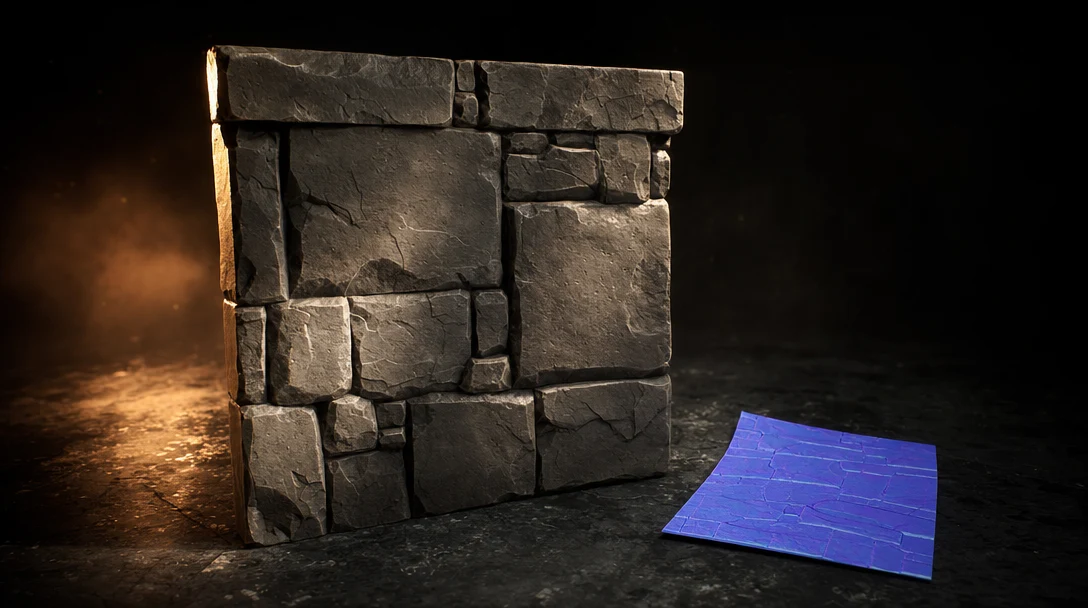
A normal map is a special texture that stores surface direction (the "normal" vector) at each pixel, telling the renderer how light should bounce off the surface. It makes a 3D model look like it has bumps, grooves, scratches, and fine detail without adding any real geometry. The mesh stays low-poly and fast, while the lighting reads as if millions of extra polygons were there. Normal maps are a cornerstone of modern game and real-time rendering, and they are one of the first material maps you should inspect on an AI-generated 3D asset.

What a Normal Map Actually Stores

Every point on a 3D surface has a *normal*: a vector that points straight out from the surface and tells the lighting engine which way that point is "facing." Lighting calculations depend almost entirely on these normals. If the renderer thinks a point faces the light, it looks bright; if it thinks it faces away, it looks dark.

A normal map hijacks that system. Instead of reading the normal from the underlying geometry, the renderer reads a per-pixel normal from a texture. That texture encodes a direction in its RGB channels:

  • The red channel stores the left/right tilt (X axis).

  • The green channel stores the up/down tilt (Y axis).

  • The blue channel stores how much the normal points outward (Z axis).

This is why normal maps look mostly purple-blue. A flat, untilted surface encodes to roughly RGB (128, 128, 255), and that lavender color dominates the map. The colorful streaks you see are places where the surface is "tilted" to fake a bump or a crease.

The result: a perfectly flat polygon can be lit as if it had rivets, fabric weave, brick mortar lines, or pores in skin. The silhouette stays flat, but the lighting tells a richer story.

How a Normal Map Works Step by Step

  1. A high-detail source is created or captured. This is usually a high-poly sculpt, a photo-scanned surface, or a procedurally generated height pattern.

  2. That detail is *baked* (or generated) into a normal map by recording how each point's normal differs from the low-poly surface it will sit on.

  3. The map is applied to a low-poly mesh in the material, plugged into the "normal" slot.

  4. At render time, the GPU reads the map per pixel and perturbs the lighting normal before shading.

  5. Light, shadow, and reflections respond to the faked detail in real time, from any angle.

The key idea: the geometry is cheap, but the *lighting* is detailed. That trade is what makes normal maps so valuable in performance-sensitive contexts.

Tangent-Space vs Object-Space Normal Maps

Not all normal maps are the same, and confusing the two is a common cause of broken-looking assets.

Type

Looks like

Best for

Trade-off

Tangent-space

Mostly purple-blue

Deforming, animated, or reusable meshes; tiling materials

Slightly more shader cost; must match the mesh's UVs and tangents

Object-space

Rainbow of colors

Static, non-deforming props baked to one specific mesh

Cannot be tiled or reused; breaks if the mesh deforms

Height map (bump)

Grayscale

Simple bumps, parallax input, source for generating normals

No directional detail; less accurate than a true normal map

World-space

Rainbow, view-dependent

Rare; specialized rendering setups

Locked to world orientation; almost never used for game assets

For the vast majority of AI 3D assets, games, and real-time work, you want tangent-space normal maps. They survive animation and rigging, tile cleanly, and are what nearly every engine expects by default.

Why Normal Maps Matter for AI-Generated 3D

AI generators have made it trivial to produce a textured mesh from an image or a prompt. The catch is that "textured" and "production-ready materials" are not the same thing. Many text-to-3D and image-to-3D outputs ship with a single baked color texture and no clean, separated material maps at all.

Normal maps matter here for a few concrete reasons:

  • They decouple detail from polycount. A generated mesh might be unevenly dense in some places and bare in others. A normal map lets you keep a clean, optimized mesh while restoring fine surface detail.

  • They reveal whether the AI output is real material data or just a pretty preview. A flat color map baked onto a noisy mesh can look fine in a turntable, then fall apart the moment you light it properly.

  • They are reusable. A good tiling normal map for metal, fabric, or stone can be reapplied across many assets, which is how studios keep a consistent look.

  • They are engine-friendly. Unity, Unreal, Blender, and web (glTF) all read normal maps natively, so an asset with a clean normal map is far closer to drop-in ready.

If a generated asset includes a normal map, do not assume it is correct. AI-produced normal maps can be inverted, too noisy, mismatched to the color texture, or baked from geometry that no longer exists after retopology. The map needs to be judged on the actual mesh, under real light.

How to Check a Normal Map Properly

A normal map is a lighting tool, so it only proves its value under lighting. Reviewing it as a flat thumbnail tells you almost nothing. Use this process instead:

  1. Apply the map to the asset in a real material, in the correct normal slot.

  2. Add a directional or point light and move it around the surface.

  3. Rotate the camera. Believable detail stays consistent; faked or broken detail "swims" or pops.

  4. Watch the grazing angles, where light hits the surface almost sideways. This is where a good normal map sells the illusion and a bad one shows its seams.

  5. Toggle the normal map on and off. The silhouette should not change at all; only the surface lighting should.

  6. Compare it against the base color texture. Detail should line up. Grooves in the color map should be grooves in the normal map, not random noise.

  7. Check for inversion. If bumps look like dents and dents look like bumps, the green channel is likely flipped (the classic OpenGL vs DirectX difference).

Inspecting assets this way, in scene context with controllable lighting and camera, is exactly the kind of review a workflow workspace is built for. In Customuse, generated meshes, their material maps, scene lighting, camera, and export all live in one canvas, so a normal map can be judged the way it will actually be used rather than as an isolated image. That review step is where many "good-looking" AI outputs get caught before they reach an engine.

Normal Map vs Real Geometry: The Decision

The single most useful question when you are deciding between a normal map and real modeling is: does the detail need to change the object's outline?

  • If the detail affects the silhouette (a bolt sticking out, a deep notch, a handle), it needs geometry. A normal map cannot move the edge of the object; it only changes how the flat surface is lit.

  • If the detail lives on the surface (panel lines, fabric weave, scratches, fine bevels, pores), a normal map is usually the efficient choice.

A sci-fi wall panel is the classic example: the deep recesses that break the silhouette should be modeled, while the hundreds of tiny screws, rivets, and surface scratches belong in the normal map. Modeling all of it would tank performance for no visual gain.

What a normal map must never do is *hide* a broken model. If the base mesh has bad topology, holes, or distortion, a normal map will not save it. The right order is always: get the geometry right first, run retopology if needed, then layer material detail on top. Normal maps are the finishing pass, not the foundation.

Common Mistakes With Normal Maps

  • Wrong format flip. OpenGL and DirectX interpret the green channel in opposite directions. A map baked for one engine looks inverted in the other. If detail is reading inside-out, invert the green channel.

  • Treating it as color. Normal maps must be imported as *linear* / non-color data. Importing them with sRGB color correction muddies the directions and weakens the effect.

  • Mismatched UVs or tangents. Tangent-space maps depend on the mesh's UV layout and tangent basis. Re-unwrapping or re-importing with different settings can break the map. Clean UV unwrapping keeps normal maps stable.

  • Over-strong intensity. Cranking the normal strength produces a plasticky, exaggerated look and harsh seams. Subtle is almost always better.

  • Baking from geometry that no longer exists. If you retopologize or optimize a mesh after baking, the normal map may no longer line up. Bake from high to low *after* the low-poly is final.

  • Using it to fake silhouette detail. It cannot. Detail at the edges still needs geometry or LODs tuned for distance.

Where Normal Maps Fit in the Material Stack

A normal map is one channel in a larger PBR material set. On its own it shapes how light bends across the surface, but it works alongside base color (albedo), roughness, metalness, ambient occlusion, and sometimes height. The normal map handles *directional* surface detail; roughness handles how sharp or diffuse the reflection is; metalness handles whether the surface behaves like metal. Judging any one map in isolation is misleading. They are read together by the shader, and an AI-generated asset is only "material-ready" when the whole set is clean, separated, and consistent.

This is why surface detail is best handled as part of a full production workflow rather than a one-shot export: generate the mesh, fix geometry, build or repair the material maps, light it in scene context, and only then export to GLB, FBX, or USD for the target engine.

FAQ

What does a normal map do?

A normal map changes how light interacts with a surface by storing a per-pixel direction (the surface normal) in its RGB channels. This makes small detail like grooves, scratches, and bumps appear three-dimensional under lighting, even though the underlying mesh stays flat and low-poly.

Is a normal map the same as real geometry?

No. A normal map only changes how the surface is lit; it never changes the actual shape or silhouette of the model. If a detail needs to affect the object's outline or cast a real self-shadow, it requires geometry, not a normal map.

Why do games use normal maps?

Games use normal maps to deliver high visual detail while keeping polygon counts low for performance. Faking surface detail through lighting is far cheaper to render than modeling every rivet, crease, and scratch, which lets a real-time engine hit its frame budget without looking flat.

Do AI-generated 3D assets include normal maps?

Some do, but many text-to-3D and image-to-3D outputs ship with only a baked color texture and no clean, separated material maps. Even when a normal map is included, it can be inverted, too noisy, or mismatched to the mesh, so it should be inspected on the model under real lighting before you treat it as production-ready.

What is the difference between a normal map and a bump map?

A bump map is a grayscale height image that only pushes detail in or out along one direction. A normal map is an RGB image that stores full directional information, so it can fake detail tilted in any direction and produces far more accurate, convincing lighting. Bump (height) maps are still useful as source data or for parallax effects, but normal maps are the modern standard for surface detail.

How do I fix a normal map that looks inverted?

If bumps look like dents, the green channel is usually flipped because of the OpenGL vs DirectX convention difference. Invert the green channel of the normal map (most engines and texture tools have a one-click option), and confirm the texture is imported as linear, non-color data rather than sRGB.


More resources

Troubleshooting Common Issues in Customuse

Troubleshooting Common Issues in Customuse

Quick fixes for the most common Customuse issues — stuck generations, export problems, sign-in trouble, and credits.

Contact Customuse: How to Reach the Team

Contact Customuse: How to Reach the Team

The fastest ways to get in touch with Customuse — Discord, email, and our social channels — and which one to use.

How to Report a Bug in Customuse

How to Report a Bug in Customuse

What to include in a bug report and where to send it so the Customuse team can reproduce and fix it quickly.

How to Request a Feature in Customuse

How to Request a Feature in Customuse

How to suggest a new feature or improvement to Customuse, and what makes a request easy to act on.

Account, Billing & Subscriptions Help

Account, Billing & Subscriptions Help

Manage your Customuse account, plan, and payments — and find the steps for cancelling, refunds, and account deletion.

AI 3D Asset Generator: From Concept to Production-Ready

AI 3D Asset Generator: From Concept to Production-Ready

A production-focused guide to AI 3D asset generators, from concept speed to topology, texturing, rigging, export, and team workflow.

AI 3D Model Generator: How to Choose One for Real Production

AI 3D Model Generator: How to Choose One for Real Production

A practical guide to AI 3D model generators, what they can do today, and why the best workflow is more than a prompt-to-mesh tool.

AI 3D Node Editor: The Workflow Layer for Modern 3D Creation

AI 3D Node Editor: The Workflow Layer for Modern 3D Creation

How AI 3D node editors turn generation, references, models, textures, agents, and exports into visible workflows teams can control.

AI Agents for 3D Game Art

AI Agents for 3D Game Art

A practical explanation of AI agents for 3D game art, based on Customuse Shorts showing node-based workflows for concept, high-poly generation, retopology, baked normals, and engine handoff.

AI Texture Generator for 3D Assets: Production Checks

AI Texture Generator for 3D Assets: Production Checks

AI texture generators can speed up 3D asset creation, but production workflows need material control, consistency, UV quality, and lighting tests.

GLB vs FBX for AI 3D Assets: Which Format Should You Export?

GLB vs FBX for AI 3D Assets: Which Format Should You Export?

GLB and FBX serve different 3D workflows. Learn how to choose the right export format for AI-generated assets, games, web 3D, VFX, and review.

Sloyd vs Meshy vs Customuse: Assets, AI, or Workflow?

Sloyd vs Meshy vs Customuse: Assets, AI, or Workflow?

Compare Sloyd, Meshy, and Customuse by structured asset control, AI 3D generation, game asset workflow, scene context, and production handoff.

AI 3D for Cinematic Content: Scenes, Cameras, Shots

AI 3D for Cinematic Content: Scenes, Cameras, Shots

AI 3D can help cinematic creators plan shots, generate assets, build scenes, control cameras, and move from prompts into visual production.

OBJ vs FBX for 3D Workflows: A Guide for AI Assets

OBJ vs FBX for 3D Workflows: A Guide for AI Assets

OBJ and FBX are both common 3D formats, but they solve different workflow problems. Compare them for AI-generated assets, games, VFX, and DCC tools.

AI 3D for Creative Agencies: Concepts to Client Review

AI 3D for Creative Agencies: Concepts to Client Review

AI 3D can help creative agencies create campaign visuals, product scenes, brand worlds, pitch assets, and client-ready prototypes faster.

GLB vs OBJ for Web 3D and AI Assets

GLB vs OBJ for Web 3D and AI Assets

GLB and OBJ are useful for different 3D workflows. Compare them for web 3D, AI-generated assets, review, materials, and production handoff.

Best AI 3D Tools for VFX Artists, Ranked and Scored

Best AI 3D Tools for VFX Artists, Ranked and Scored

VFX artists should compare AI 3D tools by shot control, scene context, asset reuse, camera direction, material quality, and handoff.

Kaedim Alternatives: AI 3D Production & Pipelines

Kaedim Alternatives: AI 3D Production & Pipelines

Compare Kaedim alternatives by production asset needs, AI generation speed, workflow control, review, exports, and team handoff.

How to Optimize AI 3D Assets for Games

How to Optimize AI 3D Assets for Games

AI 3D assets need optimization before game use. Check polycount, topology, materials, textures, LODs, scale, collision, and engine import.

AI 3D Tools for VFX: Scene Control Beats Prompt Rerolls

AI 3D Tools for VFX: Scene Control Beats Prompt Rerolls

A guide to AI 3D tools for VFX, cinematic workflows, scene control, camera blocking, continuity, and directed AI rendering.

Customuse vs Tripo: Image-to-3D or Full AI 3D Workflow?

Customuse vs Tripo: Image-to-3D or Full AI 3D Workflow?

Compare Customuse and Tripo across image-to-3D, text-to-3D, game assets, workflow control, collaboration, agents, and production handoff.

AI 3D Asset Pipeline: From Prompt to Production-Ready Files

AI 3D Asset Pipeline: From Prompt to Production-Ready Files

An AI 3D asset pipeline turns generation into usable production work. Learn the steps from prompt and reference to cleanup, materials, export, and review.

What Is 3D Model Rigging? A Guide for AI Assets

What Is 3D Model Rigging? A Guide for AI Assets

3D model rigging creates the controls that let a model move. Learn what rigging means for AI-generated assets, games, VFX, and animation.

AI 3D Tools for Game Assets: Concept to Engine-Ready

AI 3D Tools for Game Assets: Concept to Engine-Ready

A production-focused guide to choosing AI 3D tools for game assets, covering concepts, meshes, retopology, PBR textures, rigging, and engine exports.

How to Prepare AI 3D Models for Animation

How to Prepare AI 3D Models for Animation

AI-generated 3D models often need cleanup before animation. Check topology, rigging needs, scale, materials, pivots, and export path.

AI 3D to Blender Workflow: Model to Editable Asset

AI 3D to Blender Workflow: Model to Editable Asset

A practical AI 3D to Blender workflow for inspecting generated models, cleaning geometry, checking materials, and preparing assets for production.

How to Export AI 3D Assets for Blender: A Checklist

How to Export AI 3D Assets for Blender: A Checklist

Exporting AI 3D assets for Blender requires checks for format, geometry, scale, materials, textures, normals, cleanup, and scene context.

Image to 3D Model: From Reference to Usable Asset

Image to 3D Model: From Reference to Usable Asset

Learn how image-to-3D tools work, where they fail, and how to turn a reference image into an asset that can move into a real 3D workflow.

SVG to 3D Model: Turn Vector Art Into Usable 3D

SVG to 3D Model: Turn Vector Art Into Usable 3D

SVG-to-3D workflows can turn logos and vector shapes into 3D assets, but production needs depth, materials, bevels, scene context, and export checks.

What Are LODs in 3D Game Assets? A Practical Guide

What Are LODs in 3D Game Assets? A Practical Guide

LODs help game engines render 3D assets efficiently at different distances. Learn what LODs mean for AI-generated game assets.

3D AI Studio Alternatives: Multi-Model AI 3D Tools

3D AI Studio Alternatives: Multi-Model AI 3D Tools

Compare 3D AI Studio alternatives by image-to-3D, text-to-3D, AI texture generation, multi-model testing, scene context, and workflow fit.

Production-Ready AI 3D Asset Checklist

Production-Ready AI 3D Asset Checklist

A practical checklist for deciding whether an AI-generated 3D asset is ready for games, VFX, product visualization, ecommerce, or studio production.

CSM AI Alternatives for 3D Model Generation

CSM AI Alternatives for 3D Model Generation

Compare CSM AI alternatives by image-to-3D, text-to-3D, production readiness, game asset workflow, VFX use cases, and scene control.

What Is Retopology? Cleaner Meshes for AI 3D Models

What Is Retopology? Cleaner Meshes for AI 3D Models

Retopology rebuilds a 3D model with cleaner geometry. Learn why it matters for AI-generated assets, games, VFX, animation, and export.

AI 3D Workflow Tool: Production Beyond a Generator

AI 3D Workflow Tool: Production Beyond a Generator

A category-defining guide to AI 3D workflow tools and why nodes, agents, collaboration, memory, and exports matter after the first model.

World Models Need 3D Workflows

World Models Need 3D Workflows

World models can generate spatial possibility, but creators and teams need workflows for assets, scenes, materials, cameras, review, and export.

UV Unwrapping AI 3D Models: Clean Texture Maps

UV Unwrapping AI 3D Models: Clean Texture Maps

UV unwrapping maps 3D surfaces to 2D texture space. Learn why AI-generated models may need UV cleanup for games, VFX, and product visuals.

Making Game-Ready 3D Models With AI

Making Game-Ready 3D Models With AI

A practical AI game-asset workflow based on a Mars rover and alien enemy case study, covering concept generation, multi-view 3D, retopology, texturing, Unity handoff, and final inspection.

Best AI 3D Tools in 2026: Generators to Production

Best AI 3D Tools in 2026: Generators to Production

A practical guide to the best AI 3D tools by use case, including model generators, image-to-3D tools, workflow platforms, VFX tools, and game asset pipelines.

Text to STL vs Text to 3D Model: Prompts to Print

Text to STL vs Text to 3D Model: Prompts to Print

Text-to-STL and text-to-3D model workflows are not the same. Learn when to target 3D printing versus game, VFX, and scene workflows.

Text to 3D Model: From Prompt to Production Workflow

Text to 3D Model: From Prompt to Production Workflow

A guide to text-to-3D model generation, where prompts work well, where they break, and how to turn prompt outputs into usable 3D assets.

AI 3D for Indie Game Developers: Fewer Cleanup Surprises

AI 3D for Indie Game Developers: Fewer Cleanup Surprises

Indie game developers can use AI 3D for props, placeholders, style exploration, scene dressing, and workflow acceleration if they control cleanup.

AI to 3D Game Character With Skins

AI to 3D Game Character With Skins

A full AI character workflow for games, based on a Customuse tutorial covering part extraction, low-poly generation, UV cleanup, texture variants, Blender assembly, rigging, and Unreal Engine handoff.

Image to STL vs Image to 3D Model: Which to Use?

Image to STL vs Image to 3D Model: Which to Use?

Image-to-STL and image-to-3D model workflows serve different goals. Learn which one fits 3D printing, games, VFX, product visuals, and creative work.

AI 3D for Studios: From Generation to Production

AI 3D for Studios: From Generation to Production

AI 3D can help studios move faster when it supports assets, scenes, review, repeatable workflows, exports, and collaboration rather than one-off outputs.

Sloyd Alternatives: AI 3D Tools for Game Assets

Sloyd Alternatives: AI 3D Tools for Game Assets

Compare Sloyd alternatives by procedural control, image-to-3D quality, game asset fit, workflow support, exports, and production handoff.

What Are PBR Materials? A Practical Guide for AI 3D Assets

What Are PBR Materials? A Practical Guide for AI 3D Assets

PBR materials help 3D assets respond consistently to light. Learn what PBR means for AI-generated models, games, VFX, and product visuals.

Customuse vs Meshy: AI 3D Generator vs Workflow Platform

Customuse vs Meshy: AI 3D Generator vs Workflow Platform

A practical comparison of Customuse and Meshy for AI 3D generation, game assets, workflow control, team production, and exports.

AI 3D for Product Visualization: Model to Visual System

AI 3D for Product Visualization: Model to Visual System

AI 3D can help product teams create scenes, materials, environments, variations, and campaign-ready visuals faster when the workflow stays controllable.

AI 3D Workflow: How Teams Move From Prompt to Production

AI 3D Workflow: How Teams Move From Prompt to Production

AI 3D workflows help creators move from prompts and references into usable assets, scenes, exports, and production handoff.

Best AI 3D Model Generators in 2026: How to Choose

Best AI 3D Model Generators in 2026: How to Choose

A practical guide to choosing an AI 3D model generator for real creative work, from first mesh quality to scene control, exports, and production workflow.

Export AI 3D Assets for Unreal: Generation to Import

Export AI 3D Assets for Unreal: Generation to Import

Prepare AI 3D assets for Unreal Engine with checks for mesh quality, scale, materials, texture maps, import behavior, scene context, and cleanup.

AI 3D for VFX Artists: Scenes, Assets, and Shot Control

AI 3D for VFX Artists: Scenes, Assets, and Shot Control

AI 3D can help VFX artists with assets, scene setup, shot planning, references, and spatial control, but prompts alone are not enough.

Best AI 3D Tools for Game Developers in 2026

Best AI 3D Tools for Game Developers in 2026

Game developers should compare AI 3D tools by asset quality, engine readiness, optimization, material control, scene context, and export workflow.

Tripo Alternatives: Best AI 3D Tools for 2026

Tripo Alternatives: Best AI 3D Tools for 2026

Compare Tripo alternatives by image-to-3D quality, text-to-3D, workflow control, game asset fit, VFX use cases, and production handoff.

Export AI 3D Assets for Unity: A Handoff Checklist

Export AI 3D Assets for Unity: A Handoff Checklist

Exporting AI 3D assets for Unity requires checks for format, scale, pivot, materials, textures, optimization, cleanup, and scene context.

Meshy vs Tripo vs Customuse: Which AI 3D Tool Wins?

Meshy vs Tripo vs Customuse: Which AI 3D Tool Wins?

Compare Meshy, Tripo, and Customuse by generation quality, image-to-3D, text-to-3D, workflow control, game assets, VFX use cases, and production handoff.

Best Image to 3D Tools in 2026: How to Choose

Best Image to 3D Tools in 2026: How to Choose

Compare image-to-3D tools by reference quality, mesh usability, material control, scene context, exports, and production workflow.

Text to 3D Model: How to Turn a Prompt Into a Usable Asset

Text to 3D Model: How to Turn a Prompt Into a Usable Asset

Text-to-3D tools can move fast, but prompts need inspection, refinement, scene context, and export checks before the model is useful.

Generate Game-Ready Props with AI, No Cleanup Debt

Generate Game-Ready Props with AI, No Cleanup Debt

Learn a practical workflow for generating AI game props, inspecting them, placing them in context, and preparing them for engine handoff.

AI 3D Workspace: Why You Need More Than a Prompt

AI 3D Workspace: Why You Need More Than a Prompt

An AI 3D workspace gives creators control over assets, scenes, references, materials, cameras, versions, collaboration, and exports.

Production-Ready AI 3D Assets: For What, at What Cost

Production-Ready AI 3D Assets: For What, at What Cost

"Production-ready" is not a fixed label — it is ready for a specific destination and stage. How to triage AI 3D assets and decide when readiness pays.

AI VFX Tools: Where 3D Fits Into the New Creative Stack

AI VFX Tools: Where 3D Fits Into the New Creative Stack

AI VFX tools are changing how creators think about shots, assets, and production. Learn why 3D scenes and workflows matter as much as generation.

AI for VFX: Why Scenes Matter More Than Prompts

AI for VFX: Why Scenes Matter More Than Prompts

Prompts are useful for AI VFX, but scenes give creators more control over camera, scale, materials, composition, and continuity.

Meshy Alternatives: AI 3D Tools for Workflows & VFX

Meshy Alternatives: AI 3D Tools for Workflows & VFX

Looking for Meshy alternatives? Compare AI 3D tools by workflow fit, image-to-3D, text-to-3D, game asset creation, VFX use cases, and production readiness.

Image to 3D Model: Turn a Reference Into a Usable Asset

Image to 3D Model: Turn a Reference Into a Usable Asset

Turning an image into a 3D model is powerful, but production workflows need more than a good preview. Here is what to check before using the asset.

AI Scene Generation: From Single Assets to Worlds

AI Scene Generation: From Single Assets to Worlds

AI scene generation is about more than producing one object. Learn how assets, layout, camera, materials, and workflow create useful 3D scenes.

Best Text to 3D Tools in 2026: What to Compare

Best Text to 3D Tools in 2026: What to Compare

A practical guide to text-to-3D tools, prompt quality, model inspection, workflow fit, export formats, and production-readiness.

AI 3D Model Generator: What Matters After the First Mesh

AI 3D Model Generator: What Matters After the First Mesh

AI 3D generation is useful, but the first mesh is only the beginning. Learn what makes an AI-generated model usable in real creative workflows.

AI Agents Come to the Nodes Editor

AI Agents Come to the Nodes Editor

You can now collaborate with AI Agents directly inside the Nodes Editor — chat from a workflow, ask for node edits, and hand off larger tasks with budget controls.

More Reliable 3D Exports & Workflow Previews

More Reliable 3D Exports & Workflow Previews

Dedicated GLB/FBX export menus, transparent-background rendering, and smoother artifact reuse make getting assets out of Customuse more reliable.

Smarter Media History: Every Output Is Its Own Asset

Smarter Media History: Every Output Is Its Own Asset

Generated media is now handled as individual assets — with per-item deletion, dedicated video renditions, and faster history browsing.

Real-Time Workflow Collaboration + Auto Rig

Real-Time Workflow Collaboration + Auto Rig

Faster room joining, clearer presence, one-click workflow duplication, and a new Auto Rig node that makes 3D models animation-ready.

A Streamlined 3D Creation Onboarding

A Streamlined 3D Creation Onboarding

A refreshed homepage and onboarding flow guide new creators toward 3D and media workflows faster, with clearer model descriptions.

How to upload Roblox Classic Clothing directly into Roblox from Customuse

How to upload Roblox Classic Clothing directly into Roblox from Customuse

Send Roblox Classic Clothing directly into Roblox without leaving the Customuse Editor. This tutorial will help you navigate it. Let's get started!

How to Upload a Shirt in Roblox: a Step-by-Step Guide

How to Upload a Shirt in Roblox: a Step-by-Step Guide

Bring your Customuse designs to life in Roblox. Our guide explains how to save, publish, and upload your unique outfits to Roblox, making your avatar stand out.

How to upload a 3D Shirt or Accessory to Roblox: a Step-by-Step Guide

How to upload a 3D Shirt or Accessory to Roblox: a Step-by-Step Guide

Discover how to share your Roblox Clothes and Accessories from Customuse and use them for your Roblox Avatar. This guide will walk you through each step from saving your design in Customuse to wearing it on your Roblox Avatar.

How to upload a Hat or Mask to Roblox: a Step-by-Step Guide

How to upload a Hat or Mask to Roblox: a Step-by-Step Guide

Discover how to create Hats and Masks in Customuse for Roblox (Rigid Accessories in Roblox lingvo) and how to upload and use them on your Roblox avatar. In this guide you will go through the process from creating a Hat to wearing it on your Roblox Avatar.

How to link your Roblox account to your Customuse account

How to link your Roblox account to your Customuse account

Link your Roblox account to Customuse to upload and preview designs. Must select an account during linking (most common error). Ensure your Roblox account is set to 13+ years and you have proper permissions for group uploads.

How to Create 3D Assets with Customuse

How to Create 3D Assets with Customuse

Create 3D assets in seconds with Customuse AI - no technical skills needed! Transform ideas into game-ready models instantly. Learn the fastest method here.

How to Easily Create and Upload a Roblox Shirt on Your Phone

How to Easily Create and Upload a Roblox Shirt on Your Phone

Easily create and upload a custom Roblox shirt from your phone using the Customuse app! Remix designs, add accessories, and upload directly to Roblox. Follow this quick guide to design and sell your shirt in just minutes!

Cancel your subscription

Cancel your subscription

Looking to leave Customuse? Learn how to cancel your subscription.

Request a refund

Request a refund

How to request a refund if you have purchased Customuse Pro by mistake

Delete your account

Delete your account

Learn how to delete your account from Customuse

This site uses cookies to improve your experience. By continuing, you accept our Privacy Policy.
Manage